

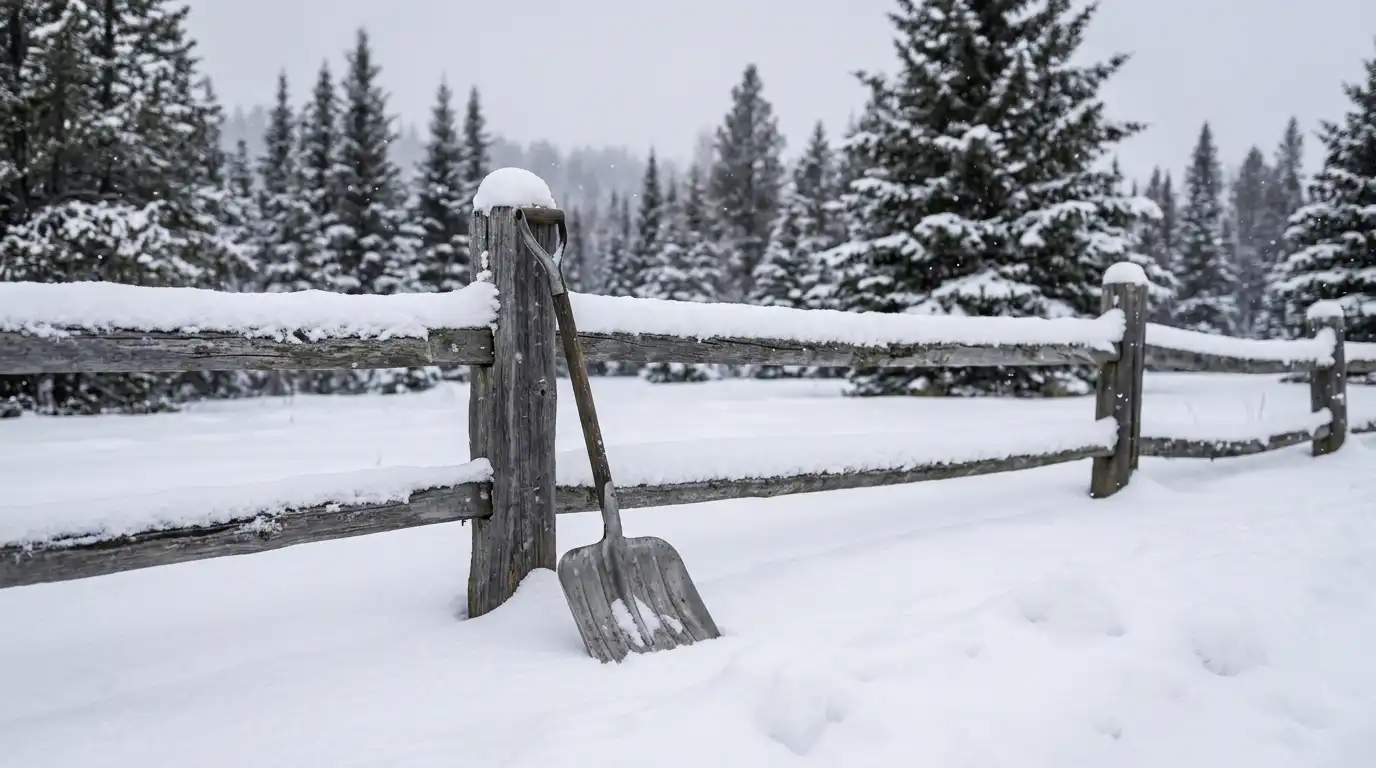
Owning a Steamboat Springs home in winter means planning for about 184 inches of snow a year in town, by NOAA’s 1991-2020 normal, a city ban on overnight street parking from November 1 to April 30, a legal duty to clear your sidewalk after every snowfall and at least daily from November 20 to April 15, and power, heat and snow-removal bills you should price before you buy.
I am Cheryl Foote, and I sell real estate in Steamboat Springs with Compass. I have lived here since 1996, and buyers ask me the same questions each October: how much snow, where do I park, who plows, and what will it cost to keep the house warm while I am away.
The Quick Take
- Snow in town: 184.5 inches a year, NOAA’s 1991-2020 normal for its Steamboat Springs station
- Snow on the mountain: 289 inches, the 10-year average in Steamboat Resort’s 2026/27 press kit
- Winter parking: no overnight parking on city streets from November 1 through April 30, 2 a.m. to 8 a.m. in most of the city
- Sidewalks: the owner, occupant or agent must clear them after every snowfall, and at least daily from November 20 through April 15
- Roof loads: set by location on the Routt County Regional Building Department’s map, and can vary within one parcel
- Season: Steamboat Resort’s scheduled opening day is November 21, 2026
How much snow does Steamboat Springs get?
In town, about 184 inches a year. NOAA’s National Centers for Environmental Information publishes 1991-2020 climate normals for its Steamboat Springs station, which sits in town at 2,092.8 meters, about 6,866 feet. The annual snowfall normal is 184.5 inches, and January is the snowiest month at 46.6 inches. NOAA labels the snowfall normal provisional: it rests on 14 qualifying years, against 22 to 27 for the station’s temperature normals. Treat it as a well-founded average, not a promise for any one winter.
| Month | Snowfall (inches) | Average high (°F) | Average low (°F) |
|---|---|---|---|
| October | 6.9 | 59.3 | 26.1 |
| November | 23.3 | 42.9 | 16.4 |
| December | 35.8 | 30.4 | 6.3 |
| January | 46.6 | 29.2 | 4.6 |
| February | 35.7 | 34.3 | 7.9 |
| March | 19.5 | 44.8 | 17.6 |
| April | 13.2 | 54.4 | 26.7 |
| May | 2.8 | 65.2 | 34.0 |
| Full year | 184.5 | 56.2 | 25.4 |
Source: NOAA National Centers for Environmental Information, U.S. Climate Normals 1991-2020, station USC00057936, Steamboat Springs. Snowfall normals flagged provisional by NOAA. Accessed October 2026.
Why does the resort report so much more snow?
Because it measures on the mountain. Steamboat Resort’s 2026/27 press kit gives an average annual snowfall of 289 inches over 10 years, 267.65 inches over 5 years and 318.23 inches over 20 years. The resort’s online mountain report publishes daily and season snowfall under a mid-mountain heading, and the press kit keeps mid-mountain records apart from summit records: its single-day record is 27 inches at mid-mountain and 29 at the summit. The press kit does not name the station behind those averages, while the resort’s mountain statistics page gives a different 10-year average, 314 inches, measured at mid-mountain. For shoveling and plowing at a house in town, use the NOAA figure. For deciding whether a ski-in condo is worth its premium, use the resort’s; my Mountain Area guide covers that decision.
What does a Steamboat winter look like in numbers?
The same normals show snow an inch or more deep on the ground about 151 days a year, an overnight low of 0°F or colder on about 38 days, and a daytime high at or below 32°F on about 61. Heating degree days total about 8,871 a year at the Steamboat station against 5,862 at Denver International Airport, about 50 percent more heating demand by that measure. In half of years the last spring freeze of 32°F or colder comes on or after about June 9 and the first fall freeze on or before about September 12, a typical frost-free window of about 93 days. That window shapes when exterior painting, landscaping and outdoor plumbing get scheduled.
What are the winter parking rules in Steamboat Springs?
From November 1 through April 30, the City of Steamboat Springs prohibits parking on city streets and shoulders during set overnight hours so crews can plow and haul snow. The hours depend on the area.
| Area | No parking |
|---|---|
| Lincoln Avenue | 3 a.m. to 6 a.m. |
| Stockbridge Transit Center | Midnight to 4 a.m. |
| Ski Time Square | 3 a.m. to 6 a.m. |
| Anglers Drive area and south to city limits | Midnight to 8 a.m. |
| All other areas | 2 a.m. to 8 a.m. |
Source: City of Steamboat Springs, Parking page, winter rules for November 1 to April 30. Accessed October 2026.
The city says a vehicle left on a street during those hours may be ticketed, or towed during snowplow operations. The code does not list the fine for a winter parking ticket: Section 23-33 of the municipal code has the Municipal Court set the schedule of traffic fines, so ask the court for the current figure.
Owners carry a second parking duty. Section 23-2 of the Steamboat Springs Revised Municipal Code makes every property owner responsible for maintaining off-street parking from November 1 through April 30 for anyone with a vehicle who lives in or occupies a bed or room on the property, permanently or temporarily. The city manager may exempt a person who shows undue hardship. If you plan to rent the home, count your spaces against the vehicles your guests will bring, and read my short-term rental rules guide for the licensing side.
Who clears the snow: the city, the county or you?
The city clears city streets, the Colorado Department of Transportation clears US 40, Routt County clears county roads, and you clear everything that belongs to your property, including the berm the plow leaves across your driveway.
The city plows by priority. Its winter snow removal page puts emergency vehicle routes first, then bus and commercial routes, then residential areas. The 5 miles of US 40 through town, Lincoln Avenue, are CDOT’s responsibility. On residential streets crews push snow to each side, into what the city calls the snow storage area: the first five feet from the outside edge of the asphalt or curb and gutter, on private property but within the public right-of-way. In an October 7, 2026 release, Public Works told owners to remove landscaping materials, particularly rocks, from within six feet of the roadway, because that strip is for snow storage and rocks damage plows.
Check the street sign on any house you look at. The city’s Streets Division says blue signs mark streets accepted for city maintenance and brown signs mark privately owned and maintained streets. A brown sign means the city does not plow that road, so find out who does and what it costs.
What does the owner have to clear?
Driveways, parking areas and the windrows plows leave across driveways are the owner’s, the city states. Sidewalks are yours too, and the rule has teeth. Section 20-5 of the municipal code requires the owner, occupant or agent of the owner of any building, property or vacant lot to remove snow and ice from the adjoining sidewalks immediately after every snowfall, and at least daily from November 20 through April 15. A violation is a public nuisance the city may summarily abate, and a person injured because an owner failed to comply has a cause of action for damages against that owner. If you are not here, someone has to do this for you.
Where the snow goes matters too. Section 15-6 makes it unlawful to deposit snow or ice from private property on any public street, alley, right-of-way or other public property, and makes the owner or occupant liable for resulting injuries. You may push snow onto your own property as long as it does not interfere with city plowing or block drivers’ sight lines, but not into the city’s snow storage area: the city’s snow page says snow from private property and sidewalks must stay out of that first five-foot strip. A December 2024 city release adds that plowing snow directly into a waterway violates the municipal code, and asks owners not to pile snow on storm drains.
What if the house is outside city limits?
Routt County’s Road and Bridge Department plows about 160 miles of paved road and 500 miles of gravel road in winter, and does not maintain state highways, streets in incorporated towns or private roads. It runs one plow shift for every class of road and warns that after a big storm some roads may not be plowed until the afternoon or the next day. It states that pushing snow onto or across a county road is unlawful under Colorado Revised Statutes 43-5-301. Some county roads get little or no winter maintenance and close for the season, so check the county’s closure list and snow plow map before you make an offer on a rural property. My guide to buying land in Routt County covers road access more broadly.
How much snow does a Steamboat roof have to carry?
There is no single number for the valley. The Routt County Regional Building Department, which serves rural Routt County, the City of Steamboat Springs, Hayden, Oak Creek and Yampa, sets ground snow load by location and publishes it on a map searchable by parcel or address. Its instructions say the value varies across a property, so you take the value at the spot where the building will stand and use it in the formula for the roof snow load the framing must carry. Every uncovered deck built in Routt County must also have its joists and decking designed for roof snow load.
To show the range, I looked up two published addresses on the map on October 12, 2026. A downtown Lincoln Avenue address returned about 106 pounds per square foot of ground snow load, and the resort’s address on Mt. Werner Circle about 115. Values on the map’s Steamboat layer run from about 101 to about 181. These are ground loads for orientation only; your architect or engineer pulls the value for your parcel.
The city’s residential code amendments, Section 5-5 of the municipal code, add an outdoor winter design temperature of minus 15°F, a frost line depth of 48 inches, and a requirement for ice shield underlayment under the code’s ice barrier section. That last rule exists because of ice dams. The U.S. Department of Energy’s Building America Solution Center, produced by Pacific Northwest National Laboratory, explains that ice dams form when heat escaping from the house warms the roof deck under the snow above freezing; meltwater refreezes at the colder eave and can back up under the roofing. Its three main remedies are air sealing the ceiling, insulating the attic and ventilating the roof. On an older house, ask your inspector to look for staining at the eaves and in the attic.
Since July 1, 2026, the building department has applied the 2025 Colorado Wildfire Resiliency Code to new permit applications, and under it replacing 25 percent or more of an existing roof covering requires the whole roof covering to meet the new construction standard, unless the existing covering already complies with the code’s roof covering section (403.2). A large snow or ice repair can trigger that; my wildfire code guide explains the rest. Shedding snow also threatens the gas meter: Atmos Energy’s weather safety guidance says to keep roof snow and ice from landing on or burying the meter, to fix gutters that drip onto it, and to clear it gently with a broom or brush.
A heated driveway can come with a condition
Under energy code amendments the City of Steamboat Springs adopted in December 2023, now Section 5-17 of the municipal code, a new residential heated outdoor snowmelt system may not be installed unless it runs on a 100 percent renewable energy source, with limited exceptions. The Routt County Regional Building Department’s code reminders, published October 2025, require proof that the electric meter serving the system is enrolled in Yampa Valley Electric Association’s Green Choice program, and a signed owner letter agreeing to keep it enrolled, to tell any future buyer, and acknowledging that the certificate of occupancy depends on compliance. Buying a newer home with a snowmelt driveway? Ask for the permit record and the Green Choice enrollment before closing, and budget to keep it enrolled.
What does a winter season cost to run?
It depends on the house. Here is what the utilities and the city publish as of October 2026, and what you have to get quoted.
Electricity comes from Yampa Valley Electric Association, a member-owned cooperative whose territory includes Steamboat Springs, Hayden and Yampa but not the town of Oak Creek. Its Colorado rate book, Advice Letter 70, effective April 15, 2026, sets single-phase residential service at a $50.00 monthly system access cost plus $0.11900 per kilowatt-hour, with a power cost adjustment for wholesale costs added per kilowatt-hour every month. YVEA has proposed a transmission demand charge of up to $2 per kilowatt of a member’s highest one-hour demand between 5 and 9 p.m., which it says would reach bills in spring 2027 if its board approves; on October 12, 2026 its website still called it proposed. It already rebates $100 per device, up to five, for a timer on a 240-volt circuit serving a water heater, heat tape or hot tub that switches the circuit off from 4 to 9 p.m.
Natural gas comes from Atmos Energy, whose Colorado tariff lists Steamboat Springs, Hayden and Milner among the Routt County communities it serves. Residential gas is billed per hundred cubic feet, and the gas cost adjustment is filed with the Colorado Public Utilities Commission at least quarterly, so the January price can differ from October’s. Outside Atmos’s area, ask the seller what fuel heats the house and who supplies it. Either way, ask for twelve months of utility bills before you write an offer.
No public source publishes what snow removal, roof clearing or a caretaker costs in Steamboat Springs, and I am not going to invent a figure. Get at least two written quotes for each before closing, and ask a snow contractor whether it bills per visit or per season and at what depth it comes out.
| Cost line | Published figure | Source and period |
|---|---|---|
| Electric system access, single-phase residential | $50.00 per month | YVEA rate book, effective April 15, 2026 |
| Electric energy charge | $0.11900 per kWh, plus power cost adjustment | YVEA rate book, effective April 15, 2026 |
| Green Choice add-on, required for new snowmelt systems | $0.006 per kWh on 50 percent of usage | YVEA Green Choice page, October 2026 |
| City water service charge, residential (city water customers only; if a district supplies the home, ask it for its rates) | $41.72 per month in 2026, $46.59 in 2027, plus usage | Municipal code Section 25-216 |
| City water turned on or disconnected | $25 each time | Municipal code Section 25-217 |
| Snow removal, roof clearing, caretaker | No published figure | Get written quotes |
Source: Yampa Valley Electric Association, Colorado Rate Book, Advice Letter 70, effective April 15, 2026, and Green Choice page; City of Steamboat Springs Revised Municipal Code, Supplement 57, Sections 25-216 and 25-217. Accessed October 2026.
How do you get in and out of Steamboat in winter?
By road, US 40 climbs east out of town over Rabbit Ears Pass; a CDOT project description places the climb between Walton Creek Road at the east end of Steamboat Springs, mile point 135.3, and the summit at mile point 147.5. CDOT can put its passenger vehicle Traction Law and Chain Law into effect on any state highway. Under the Traction Law, as CDOT’s page read in late October 2026, passenger vehicles need tires with at least 3/16 inch of tread that are rated all-weather or winter (mountain-snowflake icon, M+S or M/S), or chains or an approved alternative traction device, and CDOT highly recommends all-wheel or four-wheel drive in the mountains. Under the Chain Law, the last step before a highway closes, every vehicle needs chains or an approved device. CDOT lists a $100 fine plus a $33 surcharge, rising to as much as $500 plus a $157 surcharge where non-compliance led to closing a travel lane. Its December 5, 2025 storm advisory warned that Rabbit Ears could see up to two feet of snow. Check COtrip.org before you drive.
By air, Yampa Valley Regional Airport, owned and operated by Routt County, is in Hayden, 23 miles from downtown Steamboat Springs by the airport’s own count. Its 2026 spring, summer and fall schedule ends Southwest’s Denver flights on October 31, 2026. The airport’s Winter 2026/27 schedule, updated August 13, 2026, lists flights from 18 airports, with United’s three daily Denver flights running November 21, 2026 to April 11, 2027 and most other routes between mid-December and late March or early April. The airport notes schedules can change without notice. Long-term parking there is free for the first hour, then $1 an hour up to $9 a day.
What changes between ski season, mud season and summer?
Most owner dates are set in city code or by the operator.
| Date | What changes | Set by |
|---|---|---|
| November 1 | Overnight street parking ban and off-street parking duty begin; city final site inspections stop until April 1; outdoor water and sewer work and right-of-way excavation stop until May 1 without a variance | City code and Public Works |
| November 20 | Daily minimum for sidewalk clearing begins; clearing after every snowfall applies all year | Code Section 20-5 |
| November 21, 2026 | Steamboat Resort’s scheduled opening day | Resort 2026/27 press kit |
| April 2027 | Resort season ends; no exact closing date published yet | Resort 2026/27 press kit |
| April 15 | Daily minimum for sidewalk clearing ends; clearing after every snowfall still applies | Code Section 20-5 |
| April 30 | Winter parking rules end; summer time limits apply from May 1 | City parking page |
Source: City of Steamboat Springs Parking page and Public Works release of October 7, 2026; Steamboat Springs Revised Municipal Code Sections 20-5 and 23-2; Steamboat Resort 2026/27 press kit. Accessed October 2026.
Mud season is the stretch between the lifts closing and summer arriving. In town, April still averages 13.2 inches of snow and May 2.8 inches by NOAA’s normals, so the last of the snow melts in place through spring. Each April the Streets Division picks up the traction scoria that owners inside city limits rake from their yards onto the street shoulder.
Construction has its own season. Public Works does not perform final site inspections for single-family and duplex certificates of occupancy between November 1 and April 1, weather permitting, so a new home that misses the fall window can wait until spring. Buying new construction with a winter closing? Ask the builder whether the final site inspection is done or booked before November 1. My new construction guide covers the projects underway.
What should an absentee owner do before winter?
An empty house is where winter problems get expensive, because nobody is there to notice them. My checklist for owners who will be away:
- Know who pays for frozen pipes. Section 25-47 requires the owner to keep pipes and fixtures from the main to the premises in good order so as to prevent freezing, and to repair any that freeze or leak at the owner’s cost. Agree on a heat setting with your plumber or caretaker.
- Shut water off through the right channel. For city water, Section 25-46 makes it unlawful for anyone but Public Works or its authorized representatives to turn water on or off at the curbstop or building supply shutoff, and Section 25-42 makes it the owner’s duty to notify Public Works when premises are vacated so water may be shut off.
- Name a snow agent. Section 20-5 places the sidewalk duty on the owner, occupant or agent. Put the contractor’s scope in writing: sidewalk, driveway windrow, and where snow is stored on your lot.
- Arrange a caretaker. Get quotes, ask for proof of insurance, and agree on a visit schedule with a report after big storms and cold snaps.
- Keep the gas meter and vents clear. Atmos Energy also asks owners to keep external vents for dryers and other gas equipment clear.
- Control the heat tape. For new installations, Section 5-17 requires automatic controls that switch roof and gutter heat tracing off above 40°F and when there is no moisture.
- Save the emergency numbers. For a suspected gas leak, Atmos says to leave the area and call 911 and its 24-hour line, 866-322-8667, from a safe distance.
- Read the rules before you rent. Renting while you are away has its own licensing, tax and management rules; see my guide to financing and managing an investment property.
Where to check this yourself
- NOAA 1991-2020 climate normals, station USC00057936: ncei.noaa.gov
- Steamboat Resort 2026/27 press kit: steamboat.com
- City winter parking rules: steamboatsprings.net
- City snow removal and snow storage: steamboatsprings.net
- Steamboat Springs Revised Municipal Code: library.municode.com
- Routt County winter maintenance and plow map: co.routt.co.us
- Routt County ground snow load map: Routt County snow load mapper
- YVEA Colorado rates: yvea.com
- CDOT Traction Law and Chain Law: codot.gov
- Yampa Valley Regional Airport winter schedule: flysteamboat.com
Frequently Asked Questions
How much snow does Steamboat Springs get a year?
In town, about 184 inches. NOAA’s 1991-2020 climate normals for its Steamboat Springs station put average annual snowfall at 184.5 inches, with January the snowiest month at 46.6 inches; NOAA flags the snowfall normal as provisional. Steamboat Resort reports far more on the mountain: its 2026/27 press kit gives a 10-year average of 289 inches. Use the town figure for shoveling and plowing in town, and the resort figure for skiing.
Where does Steamboat Resort measure its snowfall?
Steamboat Resort’s online mountain report publishes daily and season snowfall under a mid-mountain heading, and its 2026/27 press kit keeps mid-mountain records apart from summit records. The press kit gives average annual snowfall as 289 inches over 10 years, 267.65 over 5 years and 318.23 over 20 years, without naming the station behind them, while the resort’s mountain statistics page gives a 10-year average of 314 inches measured at mid-mountain. NOAA’s town station in Steamboat Springs averages 184.5 inches for 1991-2020.
When does winter parking start in Steamboat Springs?
November 1. From November 1 through April 30, the City of Steamboat Springs prohibits overnight parking on city streets and shoulders so plows can work, from 2 a.m. to 8 a.m. in most of the city, 3 a.m. to 6 a.m. on Lincoln Avenue and in Ski Time Square, and midnight to 8 a.m. in the Anglers Drive area south to city limits. Vehicles may be ticketed, or towed during plowing, according to the city’s parking page in October 2026.
Do I have to shovel my sidewalk in Steamboat Springs?
Yes, inside Steamboat Springs city limits. Section 20-5 of the city’s municipal code requires the owner, occupant or agent of the owner of any building, property or vacant lot to remove snow and ice from adjoining sidewalks immediately after every snowfall, and at least daily from November 20 through April 15. A violation is a public nuisance, and a person injured because the owner did not comply may sue the owner for damages.
Can I plow my driveway snow into the street in Steamboat Springs?
No. Section 15-6 of the Steamboat Springs municipal code makes it unlawful to deposit snow or ice from private property on a public street, alley or right-of-way, and makes the owner or occupant liable for resulting injuries. Snow may go on your own property if it does not interfere with plowing or block sight lines, but the city says it must not go in its snow storage area, the first five feet beside the street. In unincorporated Routt County, the county states that pushing snow onto a county road is unlawful under Colorado Revised Statutes 43-5-301.
What is the roof snow load in Steamboat Springs?
There is no single figure. The Routt County Regional Building Department publishes ground snow load by location on a map, and the value can vary across one parcel, so designers take it where the building will stand and turn it into that building’s roof snow load. On October 12, 2026 the map returned about 106 pounds per square foot for a downtown Lincoln Avenue address in Steamboat Springs and about 115 for the resort’s Mt. Werner Circle address, with Steamboat-area values from about 101 to 181.
Who provides electricity and natural gas in Steamboat Springs?
Yampa Valley Electric Association supplies electricity, and Atmos Energy’s Colorado tariff lists Steamboat Springs among the communities it serves with natural gas. YVEA’s rate book, effective April 15, 2026, charges single-phase residential members $50.00 a month plus $0.11900 per kilowatt-hour, before a monthly power cost adjustment. Atmos files its gas cost adjustment with the Colorado Public Utilities Commission at least quarterly, so winter gas prices can move during the season.
Can I install a heated driveway in Steamboat Springs?
Only under conditions. Under energy code amendments the City of Steamboat Springs adopted in December 2023, a new residential heated outdoor snowmelt system must run on a 100 percent renewable source, with limited exceptions. The Routt County Regional Building Department’s October 2025 code reminders require the serving meter to be enrolled in Yampa Valley Electric Association’s Green Choice program and a signed owner letter agreeing to keep it enrolled and to tell future buyers.
What are the traction and chain laws for Rabbit Ears Pass?
Rabbit Ears Pass, east of Steamboat Springs on US 40, is a state highway, so the Colorado Department of Transportation can activate its Traction Law or Chain Law there. As CDOT’s page read in late October 2026, the Traction Law requires passenger vehicles to have tires with at least 3/16 inch of tread rated all-weather or winter, or chains or an approved traction device, and CDOT highly recommends all-wheel or four-wheel drive. The Chain Law requires chains or an approved device on every vehicle. CDOT lists a $100 fine plus a $33 surcharge.
When does Steamboat Resort open for the 2026-27 ski season?
Steamboat Resort’s scheduled opening day for 2026-27 is Saturday, November 21, 2026, according to the resort’s 2026/27 press kit, which lists the season as running to April 2027 without an exact closing date. Yampa Valley Regional Airport’s Winter 2026/27 schedule, updated August 13, 2026, shows United’s three daily Denver flights from November 21, 2026 to April 11, 2027.
Related reading
Buying a Home You Will Own Through a Steamboat Winter?
Send me the address and I will walk you through that property’s winter: who plows the street, where the snow has to go, what heats the house, and which quotes to get before you commit.
Contact Cheryl Foote
Social Cookies
Social Cookies are used to enable you to share pages and content you find interesting throughout the website through third-party social networking or other websites (including, potentially for advertising purposes related to social networking).